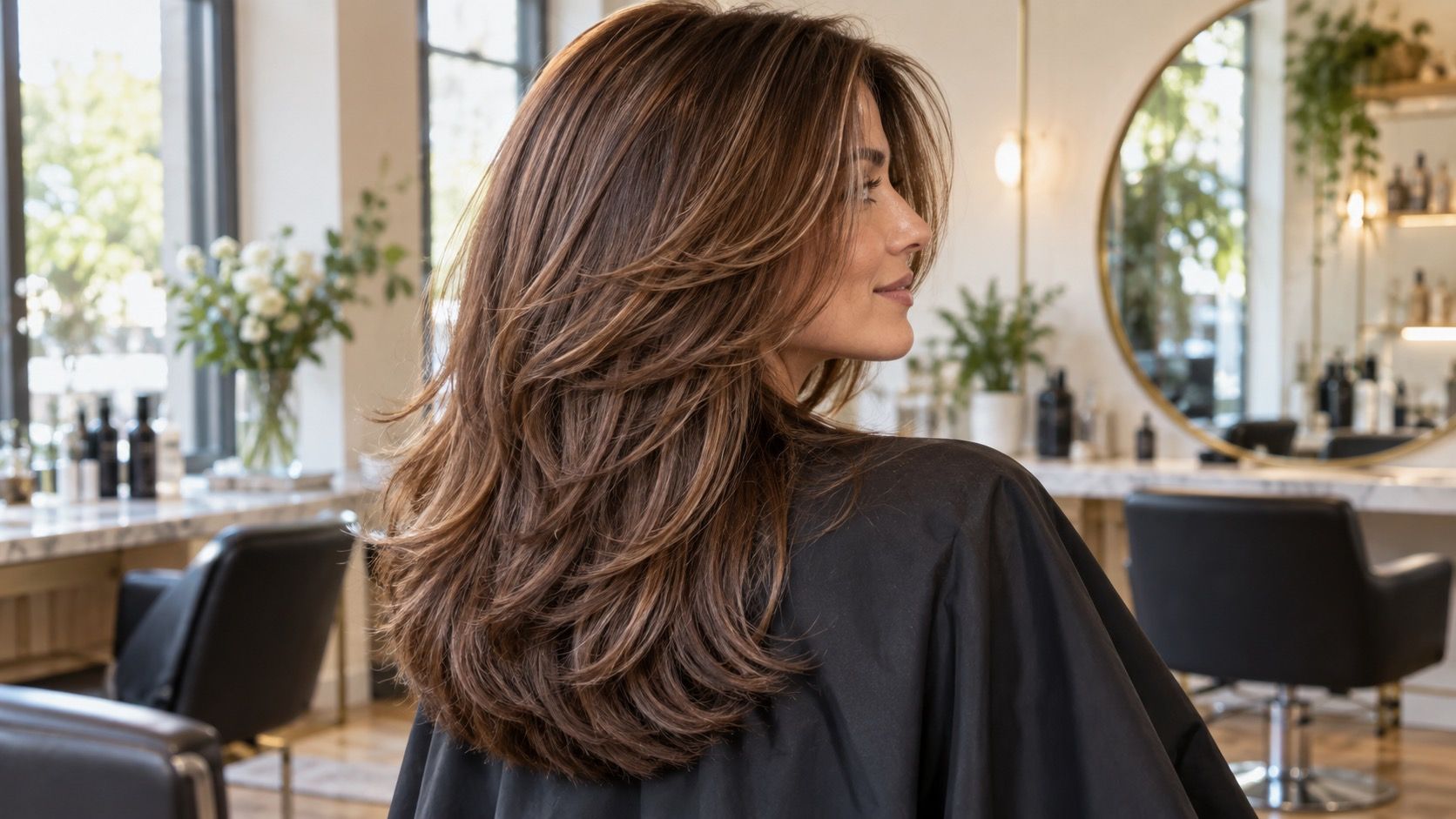
Hairstyles for square faces are often sold as ways to hide a jawline, which misses the point entirely. A defined jaw can be one of the most striking parts of a face. The useful decision is whether you want a haircut that echoes that structure, adds movement around it, or moves the visual weight somewhere else. Texture, a natural part, and how your hair dries will decide more than a rigid face-shape rule.
Notice the structure without trying to erase it
A square face commonly has a forehead and jaw that feel similar in width, with a more defined lower edge than a round face. But real faces are mixed: cheekbones may be prominent, the chin may be narrow, and one side may look different because of a part or hairline. Look in daylight with your expression relaxed. The point is to identify where the outline feels strong, not to diagnose a feature as a problem.
Ask for movement where your hair can hold it
Then look at your hair's behavior. Very straight hair with a blunt jaw-length edge makes a clear graphic statement. Loose waves or textured ends interrupt that line. Neither result is automatically better. If you love sharp shapes, there is no reason a square face cannot wear one; just ask the stylist to make the proportions intentional from the side and back as well as from the front.
Phone photos are poor judges here. A close lens exaggerates the middle of the face and can make the jaw appear broader. Use a mirror by a window and a photo taken at eye level from farther away. That small check prevents a dramatic haircut based on an unhelpful angle.
Soft layers can create movement around the temples, cheekbones, and jaw, but the word soft needs a technical meaning. On fine straight hair, it may mean a fuller baseline with a few longer face-framing pieces so the ends do not look thin. On thick wavy hair, it may mean removing bulk internally and leaving a less rigid perimeter. Cutting a stack of short layers into every texture is not softness; sometimes it is simply a recipe for puffiness.
Waves work because they break up a straight visual line, not because they are compulsory. If you already have a natural bend, a cut that lets it dry without a shelf is likely to be more convincing than a daily curling-iron routine. If your hair is very straight and you prefer it smooth, a subtle curve at the ends or a side part can provide enough movement. Ask what the cut will look like after air-drying, especially around the jaw and behind the ears.
Long layers beginning below the jaw are often quieter than short face-framing pieces that stop at the widest point. This is a useful distinction if you want length but dislike a feathered look. Show the stylist where you normally tuck your hair or wear a ponytail; those routines reveal whether the layers will feel helpful or merely escape the elastic.
Short styles and bobs can be structured on purpose
A lob at the collarbone is a flexible starting point for a square face because it leaves space for an off-center part, a wave, or a tucked side. A chin-length bob creates a strong frame near the jaw. It can look excellent when that is the look you want, but the perimeter needs a plan: very blunt, gently beveled, or textured enough to move. A cut that stops at exactly the same point all around may look much different once a natural wave dries.
Short cuts need attention at the crown and temples. A pixie with some softness through the top can be easy to wear, while an extremely tight crop may feel more graphic and expose the growth pattern. Ask how much product is needed on a normal day and how soon the nape will need trimming. The best haircut for square face should not quietly require a salon-level blowout every morning.
| Style direction | What it changes | Useful check |
|---|---|---|
| Collarbone lob | Keeps length while adding room for texture | Can I pin it back on workdays? |
| Soft perimeter bob | Frames the jaw without a hard horizontal edge | Where will it sit after air-drying? |
| Long layers | Adds movement below the strongest part of the jaw | Will the ends still feel full? |
| Textured pixie | Shows facial structure with adjustable crown lift | How often will I need a shape-up? |
Fringes and parting are small changes with real impact
A side fringe can bring diagonal movement across the forehead and blend into longer layers. Curtain bangs can open around the brow bone and remain flexible as they grow. Straight bangs make a bolder horizontal line; choose them because you enjoy that contrast, not because anyone told you they are forbidden or required. The right density depends on your hairline, brow shape, and whether you are prepared for regular trims.
Try your natural part before a cut. A side part often gives a little root lift and asymmetry, while a center part can look polished if the lengths have enough texture. Forcing a precise center line over a cowlick usually creates a split by midday. Move the part a fraction to either side after washing and see what stays without clips. That is the position a haircut needs to support.
Bring glasses to the consultation if they are part of your everyday look. A fringe that skims thick frames may feel busy, while a temple-length piece can create a calmer line. These details are easy to test before cutting and surprisingly hard to ignore afterward.
Avoid an over-shaped result by naming what you dislike
References are most helpful when you describe the component you want. Bring one image for length, one for texture, and one for fringe or parting. Say whether you like the visible jaw, the loose ends, or the lift at the crown. Also identify your no-go details: a triangular bob, a razor-heavy finish, a fringe that needs ironing, or layers that vanish when your hair is tied up. This gives the stylist real constraints instead of a vague request for softness.
Be honest about upkeep. A sharply cropped style and a full fringe can need attention every four to six weeks; a longer lob with gradual layers usually has more room to grow. Mention if you air-dry, live with humidity, use a diffuser, or have only five minutes in the morning. A strong haircut is not defined by hiding a jawline. It is the one whose structure still feels intentional after your own wash and dry.
After the first week, take a photo in your usual light and identify the practical issue, if there is one: too much weight at the ends, insufficient movement around one temple, or a part that collapses. That is useful salon language. Broad claims about what square faces cannot wear are not.