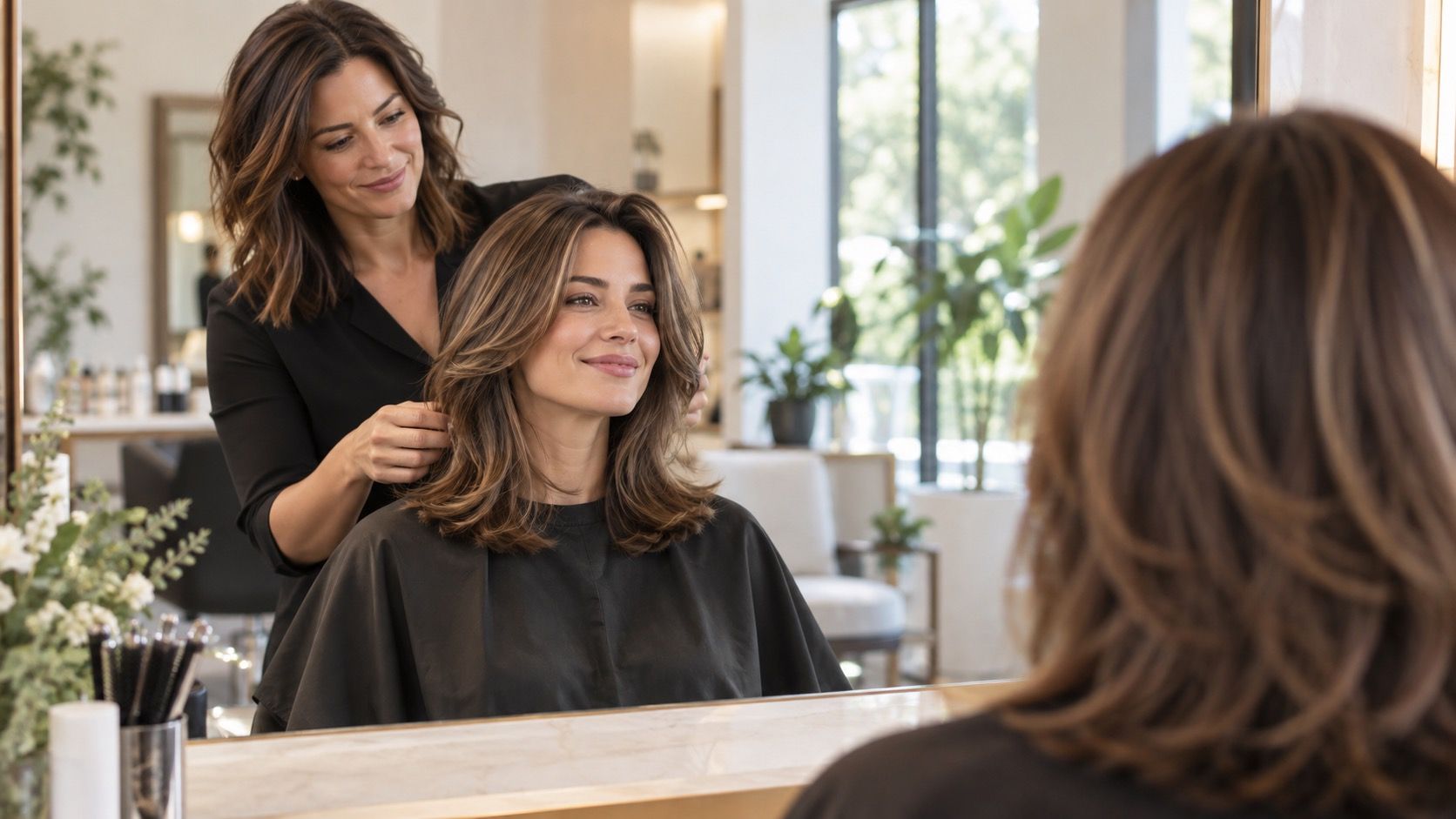
Thick hair has its own contradiction: there is plenty to work with, yet an unfocused cut can feel heavy, triangular, or impossible to dry before the day starts. The useful goal is not to remove as much hair as possible. It is to place weight where the shape needs it and remove it where the hair keeps expanding.
Decide what “too much hair” means in your case
Thick hair may mean a dense scalp, coarse strands, a strong wave pattern, or all three. Each creates bulk in a different place. Dense straight hair can stack at the ends; coarse hair can feel wide through the middle; wavy or curly hair may appear to double in width as it dries. Notice where the cut becomes difficult before asking for thinning.
Use layers where they release weight, not everywhere
Look at your hair after it has dried without a perfect blowout. If the crown is flat but the lower half flares, the answer is usually shape and layer placement, not aggressive removal at the roots. If the entire head feels heavy, the haircut may need more internal structure and a length that does not trap the hair at the widest point.
Use this part of the decision as a small at-home test rather than a rule. Notice what happens on a normal day, in the light you usually see, and after the hair has moved through your routine. A result that works only immediately after styling is less useful than one that still feels balanced later. Take a clear photo from the front and side if you are unsure; it can make the proportion, weight, or color relationship easier to discuss at the next appointment.
Thoughtful layers make thick hair bend and move. They work especially well from the cheekbones downward on medium and long cuts, because that is where a solid mass can start to look blocky. The shortest layer should still connect to the surrounding hair; isolated short pieces can puff up and create a shelf around the head.
Ask what tool will be used for weight removal. Scissors can create controlled internal space, while thinning shears or a razor can be useful in skilled hands but may leave some textures frayed or too airy at the ends. The right method depends on curl pattern, porosity, and how often you heat-style, so the word “thin” alone is not a complete instruction.
Use this part of the decision as a small at-home test rather than a rule. Notice what happens on a normal day, in the light you usually see, and after the hair has moved through your routine. A result that works only immediately after styling is less useful than one that still feels balanced later. Take a clear photo from the front and side if you are unsure; it can make the proportion, weight, or color relationship easier to discuss at the next appointment.
Short and medium cuts with enough structure
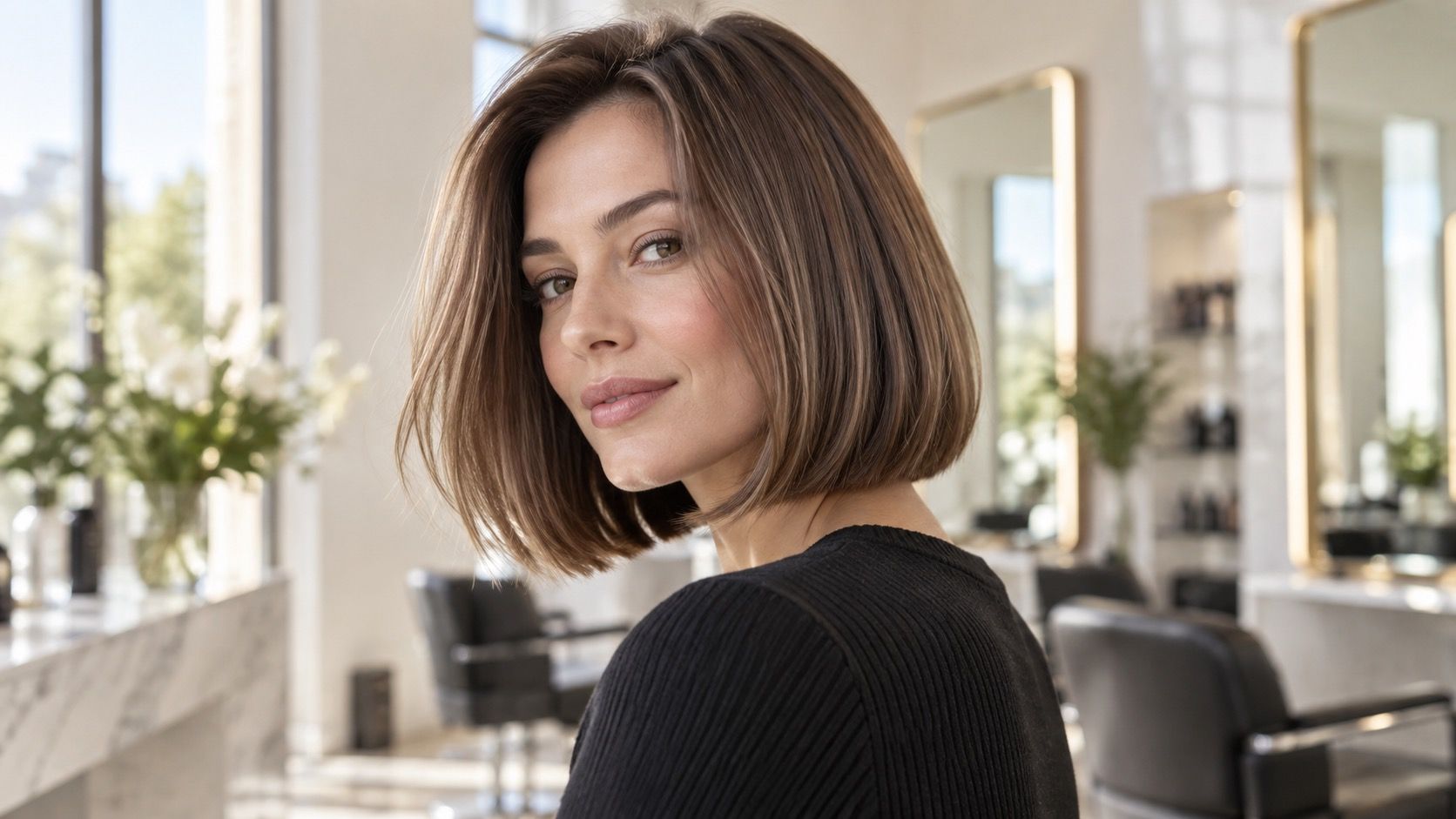
A long bob gives thick hair a clear boundary while retaining enough length to settle. It can be cut blunt at the outline with discreet layers inside, which often feels more polished than a heavily shattered finish. For a rounded face or a full jawline, a little extra length in front can keep the shape from widening at the cheeks.
A shag can be a good match when your hair already has bend or curl and you are comfortable seeing texture. It is less forgiving when the natural pattern is mostly straight but expands in humidity; then the many short layers may require more styling than expected. Bring a photo of the cut after a real day, not only a studio-styled version.
Use this part of the decision as a small at-home test rather than a rule. Notice what happens on a normal day, in the light you usually see, and after the hair has moved through your routine. A result that works only immediately after styling is less useful than one that still feels balanced later. Take a clear photo from the front and side if you are unsure; it can make the proportion, weight, or color relationship easier to discuss at the next appointment.
Long hair needs a plan for the ends
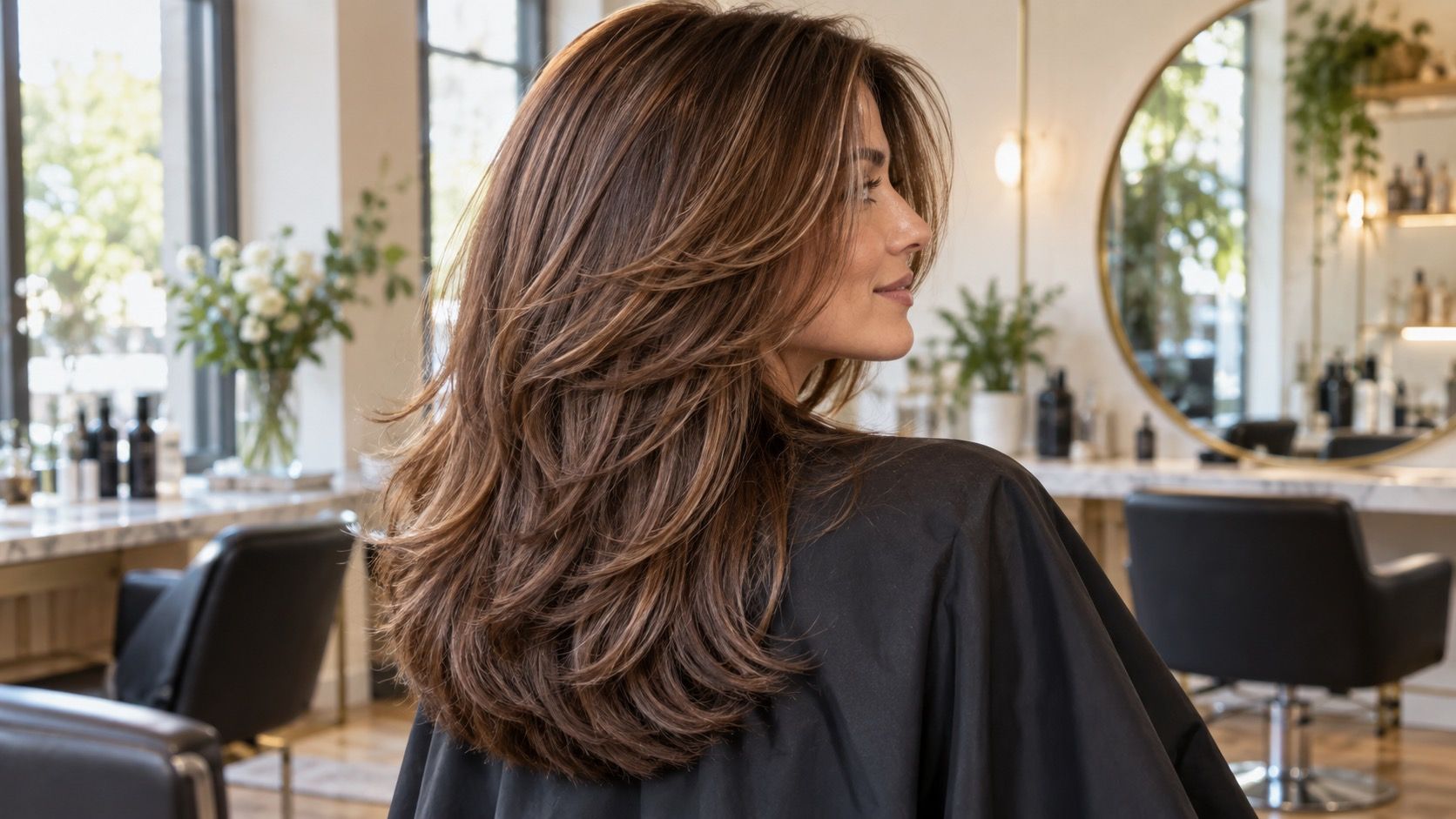
Long thick hair can become a curtain if every strand is one length, but over-layering can make the bottom look thin and uneven. A long U or soft V perimeter with blended layers often keeps the length moving without losing authority. The important test is the back view: the silhouette should look balanced rather than like a dense triangle.
Curly hair needs its own version of this conversation. Some curls spring up sharply, so a dry or curl-by-curl assessment can reveal where length will actually land. Do not borrow a straight-hair layering map without checking shrinkage. A section cut wet at the wrong tension can look much shorter and wider once the pattern returns.
Use this part of the decision as a small at-home test rather than a rule. Notice what happens on a normal day, in the light you usually see, and after the hair has moved through your routine. A result that works only immediately after styling is less useful than one that still feels balanced later. Take a clear photo from the front and side if you are unsure; it can make the proportion, weight, or color relationship easier to discuss at the next appointment.
Make peace with humidity and maintenance
No haircut can promise to erase humidity, and a style that depends on perfectly smooth hair may become exhausting in a damp climate. Decide whether you prefer to work with your natural volume or regularly blow it out. That choice should influence the length, the amount of layering, and whether fringe will be a daily commitment.
For many people, the manageable routine is simple: conditioner that gives slip, a product chosen for the natural texture, and a drying method that does not rough up the cuticle. Thick hair can take time to dry, so plan the cut around your real mornings. A beautiful style with a forty-minute routine is not low effort simply because it photographs well.
Use this part of the decision as a small at-home test rather than a rule. Notice what happens on a normal day, in the light you usually see, and after the hair has moved through your routine. A result that works only immediately after styling is less useful than one that still feels balanced later. Take a clear photo from the front and side if you are unsure; it can make the proportion, weight, or color relationship easier to discuss at the next appointment.
Ask the questions that prevent regret
Tell the stylist how your hair behaves at the gym, in rain, and on the second day after washing. Mention whether you wear it clipped up, whether you diffuse curls, and when the ends last felt too bulky. These clues reveal more than the label thick hair and help the stylist choose between length, layers, and internal weight removal.
Before the cape comes off, ask how the cut will grow out and which area is likely to need the first adjustment. The best hairstyles for thick hair should still have a readable line after several weeks. If the only maintenance advice is to use more product, ask again how the cut itself is carrying its share of the work.
Use this part of the decision as a small at-home test rather than a rule. Notice what happens on a normal day, in the light you usually see, and after the hair has moved through your routine. A result that works only immediately after styling is less useful than one that still feels balanced later. Take a clear photo from the front and side if you are unsure; it can make the proportion, weight, or color relationship easier to discuss at the next appointment.