Looking for the best hairstyle for your face shape is useful only when it gives you better questions for the mirror and the salon chair. A face-shape label can point out proportions, but it cannot predict a cowlick, the way fine hair loses volume by noon, or whether you will spend ten minutes with a brush each morning. Treat it as a starting sketch, then make the cut fit your texture, habits, and the features you want to notice.
Start with proportions, not a label
Pull your hair back loosely and look in a window rather than at a close phone selfie. Notice the widest part of your face, the length from hairline to chin, and whether the jaw reads soft, narrow, or defined. An oval outline is usually longer than wide; a round outline has gentler curves and similar width and length; a square outline often has comparable forehead and jaw width. Heart and diamond shapes tend to narrow toward the chin, although a widow's peak, glasses, and a side part can change the impression.
Choose length for the way you live
That observation is enough. Face shapes overlap, and a photograph taken from below can make nearly anyone look broader through the cheeks. Instead of trying to win a diagnosis, choose two things you see consistently: perhaps prominent cheekbones and a narrow chin, or a strong jaw with a high forehead. Those details give a haircut for my face shape a practical direction: where to put movement, where to keep weight, and whether a fringe is likely to feel natural.
Do the same check with your hair down in its ordinary state. The face is never viewed as a bare outline in daily life. A center part makes the frame more symmetrical, loose curls add width, and a dark blunt line at the jaw can look much stronger than the same cut with airy ends. The useful question is not which category you belong to; it is which silhouette you enjoy seeing when the hair is clean but not professionally styled.
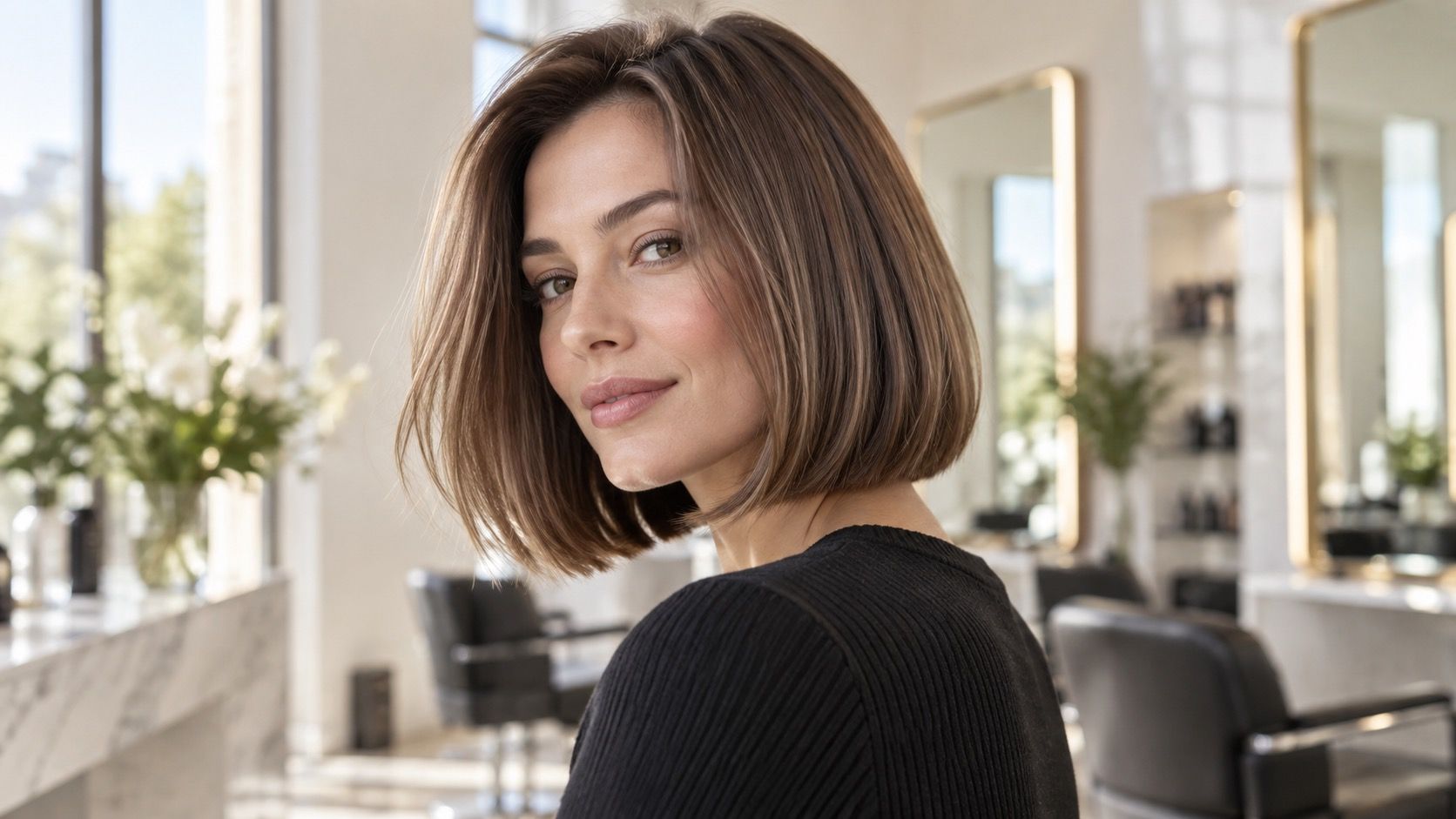
Length changes the point where attention settles. A chin-length bob brings the eye to the cheeks and jaw, while a collarbone lob leaves more vertical space and can still be pinned back. Long hair creates a longer frame, but only if its weight and texture are managed; pin-straight hair with a center part can look severe on any face when it hangs flat. None of these effects are faults. They are choices worth seeing before the cape goes on.
Ask yourself what happens after the first wash. If you air-dry dense waves, a sharp chin bob may spring up sooner than the reference photo suggests. If your hair is fine, aggressive layers can leave the last two inches looking see-through. A shoulder-length cut is often a calm test length because it can be worn smooth, waved, tucked, or tied up, and it shows a stylist how your hair behaves before you make a shorter commitment.
| What you notice | A useful starting idea | Check before cutting |
|---|---|---|
| Face reads quite round | Height at the crown, an off-center part, or movement below the cheeks | See the shape in daylight, not a wide-angle selfie |
| Jaw and forehead feel equally broad | Soft texture around the temples and a less rigid perimeter | Ask where a blunt edge will land when dry |
| Forehead feels wider than the chin | Weight near the jaw or collarbone and flexible face-framing pieces | Do not add heavy crown volume automatically |
| Face appears long | Width from waves, a fringe, or a medium-length shape | Check whether a center part exaggerates the length |
Use layers and volume as placement tools
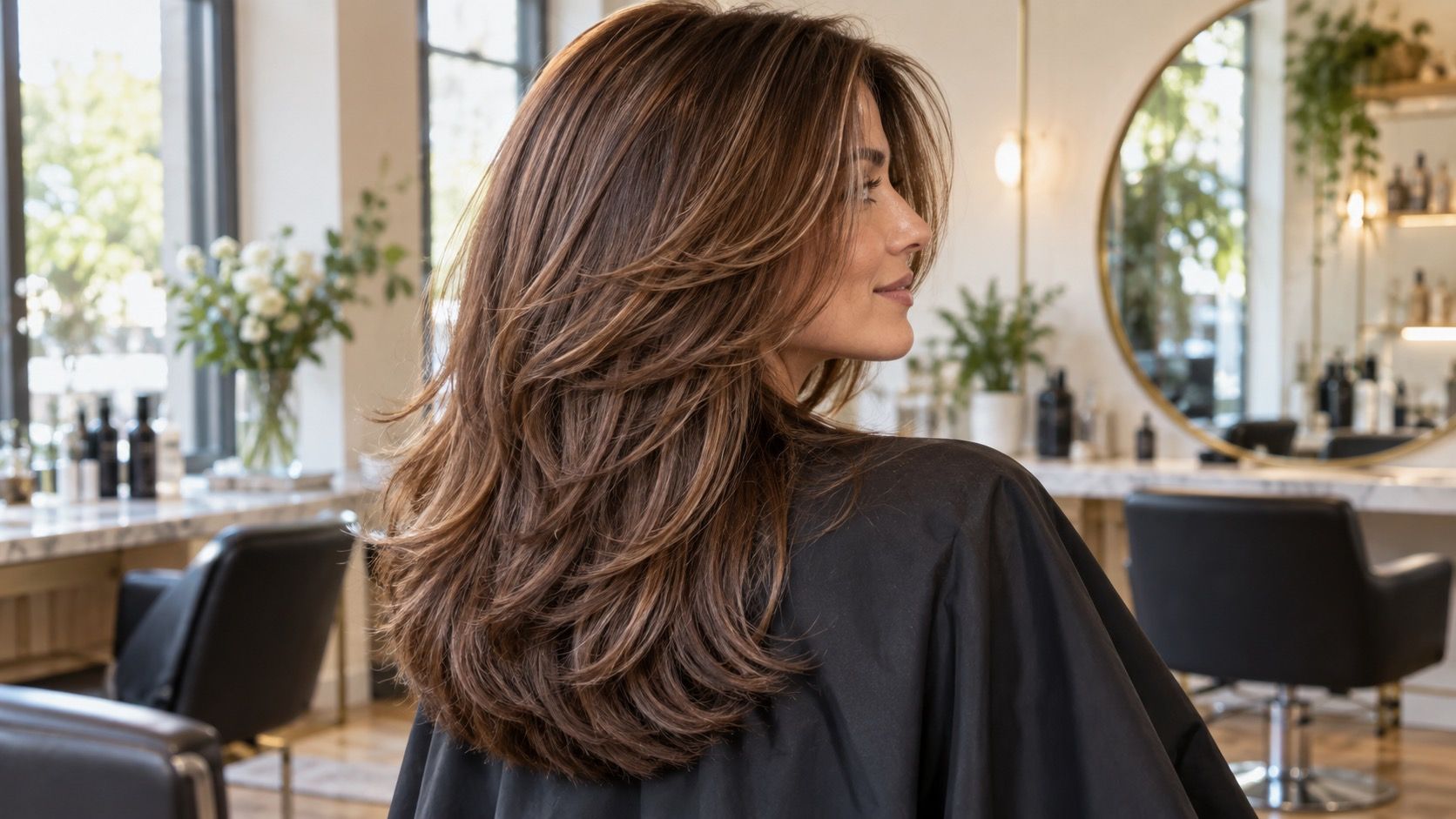
Layers are often described as universally flattering, which is too vague to help. Their starting point matters. Pieces beginning at the cheekbone make the middle of the face feel active; longer layers that begin below the jaw keep the outline quieter. On a square face, a textured perimeter can take the severity out of a very blunt baseline. On a heart-shaped face, fullness around the jaw or collarbone can make the overall outline feel steadier. The goal is not to correct a face but to decide where you want the haircut to move.
Texture changes the calculation. Fine straight hair usually needs fewer, more deliberate layers than thick hair, because every removed section affects density at the ends. Thick waves can become a broad shelf if many short layers stop at the same place. Curly hair needs its own conversation: shrinkage, curl grouping, and the crown pattern may matter more than wet length. It is sensible to ask the stylist to show the side profile before the final spray and to explain what the cut will do once it dries naturally.
Volume works in the same way. Lift at the crown can create a longer impression, while fullness at the sides can balance a narrow area. But a rounded face is allowed to have a full curly bob, and a long face is allowed to wear sleek hair. If you prefer a particular shape, the technical problem is simply to build it so it lasts longer than the walk from the salon to the car.
Match bangs and parting to your hairline
A fringe changes the frame faster than almost any other haircut decision, and it is where hair reality matters most. Full straight bangs create a clear horizontal line and can focus attention on the eyes. Curtain bangs open through the middle, blend into layers, and are usually less dramatic to grow out. A soft side fringe can create movement without asking the forehead to disappear. None of them is a mandatory answer for an oval, round, square, or heart-shaped face.
Look closely at the hairline and cowlick before committing. A fringe that fights a strong growth pattern can split every time humidity rises, regardless of how good it looked under salon lights. Bring up your glasses if you wear them; brow-length bangs and thick frames can crowd the same part of the face. It is often useful to begin longer, live with the shape for a week, then trim more. Hair grows, but an overly short fringe has an unusually long calendar.
Parting deserves the same trial. A center part offers symmetry and a vertical line. A side part creates lift and a small asymmetry that can soften a very even outline. Move your natural part half an inch in each direction after washing your hair. The position that keeps its volume without clips or constant brushing is usually the one that will make the haircut look intentional on an ordinary day.
Turn a salon reference into useful language
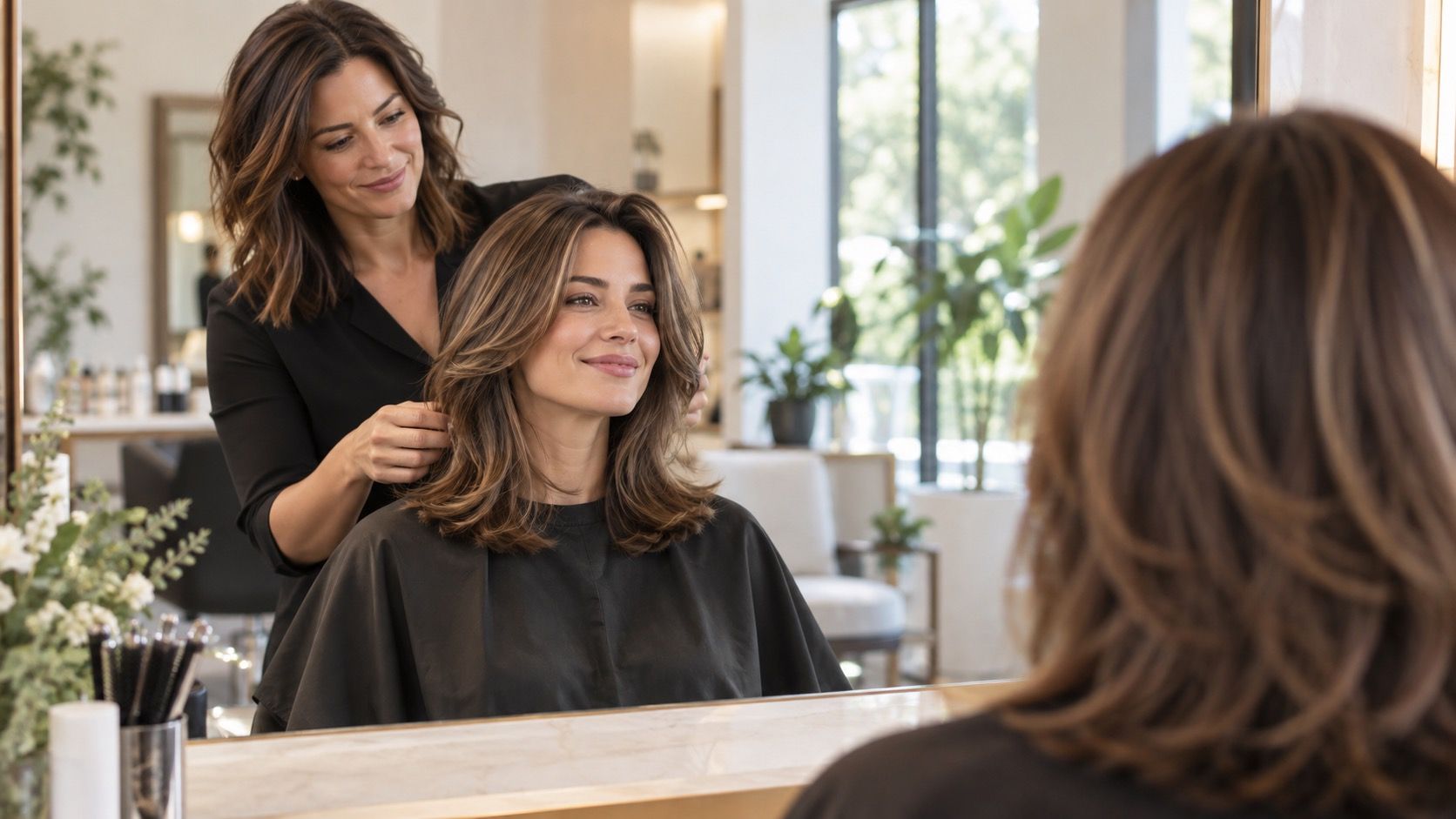
Bring three or four images that describe different parts of the result instead of asking to reproduce one person's head. One can show your preferred length, another the amount of texture, and another the fringe or parting. Say what you like in each: weight at the ends, looseness around the cheekbones, or the ability to tuck it behind an ear. Also say what has disappointed you before, whether that was layers that vanished in a ponytail, a bob that flipped outward, or bangs that separated before lunch.
Be precise about maintenance. A cropped shape and straight fringe may need a clean-up every four to six weeks; long layers can often wait longer. Mention whether you use hot tools, wash daily, work out with your hair tied up, or avoid styling products. A stylist can adapt hairstyles for face shape far more effectively with those facts than with a request to look like a chart.
Before leaving, ask for the home version of the finish: which direction to dry the fringe, whether a round brush or diffuser matters, and which part of the shape will grow out first. The best hairstyle for face shape is usually the one that still feels like yours a week later, when you have made it work with your own hands.